A REMARKABLE VISIT TO CANADA
The first visit of a British Salvation Army Band to Canada -- in the winter of 1888-1889
- Prepared by Fred Creighton,
from the files of the Archives of The Salvation Army Canada and Bermuda Territory
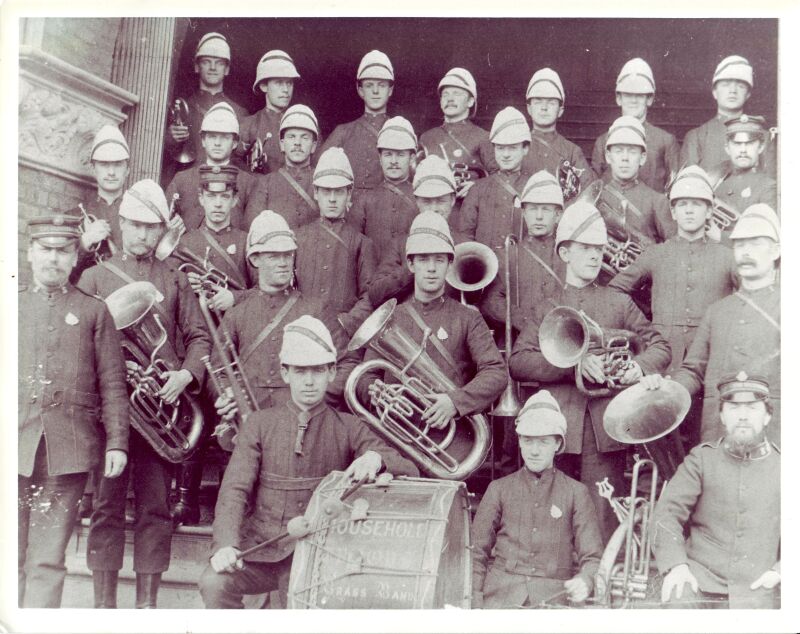 One hundred and twenty years ago, in the winter of 1888-1889, just a few years after the commencement of the Salvation Army in Canada, the Household Troops Band (HTB) of The Salvation Army from London, England visited Canada for a remarkable four and one half month campaign. The HTB was the first Salvation Army band from Britain to visit Canada (The second British SA Band visit to Canada didn’t occur until the 1952
visit of the International Staff Band. The HTB visited Canada again in 2002).
From the middle of October 1888 when the HTB arrived by ship at Montreal until the end of February 1889 when they left Canada from St. Stephen, NB, to continue their visit in the United States, they campaigned daily in many, many towns and villages in Eastern Canada, as far west as Windsor, Ontario, and as far east as Halifax, Nova Scotia. They often visited several communities in one day. In spite of snowy, freezing winter weather they usually marched through town, often with frozen valves, and held meetings in the evening.
The October 13, 1888 Canadian War Cry announced the HTB visit:
SPECIAL AND IMPORTANT
THE RENOWNED Band of the “Household Troopsâ€
(Cadets in Training at the English Homes)
in charge of STAFF-CAPT. APPLEBY
will visit the Dominion in aid of the
Canadian “Sick and Wounded†and “Poor Officers’†Funds.
The reputation of the Cadets as Musicians
and Salvation Warriors has extended all round the world.
Don’t miss a Treat and a Blessing.
The members of the Household Troops Band (Jan 26, 1889 War Cry) included:
Bandmaster: Staff-Captain Harry Appleby,
Band Members: Captain Amy, Captain Shaw, Lieutenant Tucker,
and Bandsmen Aspinal, Bengiss, Bone, Burdett, Davidson, Garlick, Graham, Green, Groom, Henderson, Kemp, Lewthwaite, Nevill, Nicholson, Northeast, Oddy, Randy, Taylor, Wildrith.
The November 10, 1888 War Cry front page featured a photo of the HTB standing in the front entrance of the Territorial Headquarters in Toronto and included this report:
HOUSEHOLD TROOPS BAND
Our Tour Through the Dominion
We are glad this week to be able to give our readers a picture of the Household Band, and also the first sheets of a description of their tour by one of themselves. The success of the visit is unprecedented and the heartiness of their welcome is as creditable to the Dominion as it is gratifying to themselves.
“It was with light hearts that we caught the first sight of the Canadian shores. We had left Liverpool some nine days when we came in sight of QUEBEC, The cliffs, surmounted by the old Citadel, were quite an imposing sight as we steamed into the river. The first thing we did was to thank God for a safe voyage and to ask His blessing on our visit to the Dominion.
On Sunday we sighted MONTREAL, where we were to disembark, and at 5.15 we were moored in the Allan dock. Col. Bailey and Major Spooner met us at the landing stage, and after prayer and a few words of welcome we marched to the barracks, where a beautiful supper was soon ready. This we enjoyed very much as it was THE FIRST SQUARE MEAL we had had since we left Liverpool. (We came out steerage, so you understand the reason.)
On Tuesday and Wednesday we assisted at the farewell meeting of the Hindoos, where God indeed blessed our souls. The sight was beautiful to see twenty lads and lasses give up their body and spirit to such a noble cause, not counting home, friends, or even their life, dear, that they might help to take the Gospel to the dark millions of India. Our prayers and love go with them.
On Thursday we held our first meeting in Montreal. Owing to the farewell meeting which had just caused so much stir and great crowds, the musical festival was pushed to the wall, but, notwithstanding this, a great crowd came to see and hear us on Thursday night. Staff-Capt. Bandmaster Appleby led the meeting, and we had a real good time. The boys were quite used to the people and quite at home. The audience appreciated the music and singing and gave liberally towards the fund for sick and wounded officers. One soul, a colored brother, came forward for salvation. At about eleven o’clock we marched to the depot, a good number of people following, including a lot of red jackets who TREATED US TO A BOUNCING before we left the depot. We started our journey soon after midnight amid the cheers and amens of those on the platform.
We reached TORONTO at 11 a.m. next morning. The Temple band and officers met us at the depot and we marched away to the Temple, where we found a real Canadian dinner prepared. At night we led a musical meeting in the Temple, the music was liked by the people, especially the bandmaster’s and big drummer’s parts. Commissioner Coornbs Col. Dowdie, Staff-Capt. Griffiths, Capt. Wiggins, and several other staff-officers took part in the meeting. We were sorry to have to leave Toronto so soon, but believe to get back again.
On Saturday we visited the little town of OAKVILLE, and the place was quite stirred as we marched through playing and singing. In the afternoon we had a meeting, two came forward to give themselves entirely into God’s keeping. At night the town hall was filled with people to listen to speaking, singing, praying and playing. Major Glover led the service, and at the close three sought pardon from their sins. Hallelujah!
We took train after the meeting for HAMILTON, where we arrived about 12 midnight. Major Woolley, Capt. Brooks, and a host of soldiers met us to take us to our billets. We were soon quite at home with them as we have learned to suit ourselves to all classes, and we found Hamilton people VERY HOME-LIKE INDEED.
We started (on Sunday) at 7 o’clock with Knee-drill, at 11 we held a Holiness meeting, at which three came for the blessing of a clean heart.
The free-and-easy (afternoon meeting) was of an interesting character. Each speaker had to tell the place of his birth, how he liked Canada, and how salvation suited them. Each one said they liked Canada and a Lieutenant said he thought he could settle down in Canada very nicely as he liked it so much. At night the meeting was well attended, the spirit of God was with us in a mighty manner and words of each speaker went right to the hearts of the people.
Just after Capt. Amy (of the band) had spoken a crash was heard, the floor of the barracks had given way. The people screamed and fainted and rushed in all directions to get away from the building, and it was with the greatest difficulty that order was restored. Had it not been for this accident we feel sure several would have come out to the penitent form, but it was so very hard to get order afterward that we were forced to close with only two at the mercy seat, feeling that we should see some more on Monday night.
The meeting on Monday evening was held at the Roller rink in Jackson Street in consequence of the accident at the Barracks. A crowd of people gathered and they listened attentively to all that was said and done. The Bandmaster’s experience brought tears form the eyes of many as he spoke of the way he had, while serving the devil, ill-treated his wife and children. He now rejoices in the fact that he is serving God and has a changed life, a happy home and the joy of trying to make some amends for his past life of sin. Praise God, He enables him to bring honor and glory to His name.
The people helped very nobly towards the Sick and Wounded (the HTB was collecting money for this fund). Seven came forward for salvation, some saying they were so impressed by the Sunday’s meetings that they were compelled to come that night and get saved. God is with us and we are believing for mighty victories further on.â€
During the visit of the HTB the Canadian War Crys (and newspapers) included many reports of their activities. Here is a small sample:
The November 17, 1888 War Cry:“Having boarded the wrong train en route to Dundas we soon learned that a march across the country lay before us. Hallelujah, away we go up hill and down hill till at last we reached the town, having done a tramp of six miles. This was all done for the salvation of souls, and the glory of God.
As the midnight train took us on toward Hamilton, the scene inside the special (railway) car was one of life. Sleep was out to the question. The boys were all busy pipe-claying their helmets, polishing up and getting read for the morrow. Praise God, not only are the helmets white and clean, and the instruments bright and shining, but our hearts are kept continually cleansed in the blood of the Lamb.â€
The December 15, 1888 War Cry:“Our visit to Whitby was short, but sweet. owing to slow trains, etc., we did not arrive in time for the holiness meeting, which of course only tended to increase the curiosity already aroused. The night meeting was a blessed success and the music hall was filled with a very respectable audience indeed.
The Autumn winds and early morning breezes are just the thing to brace a person up, as was also the tramp across the country to Oshawa; we all enjoyed it immensely, and as the troops formed up and marched into town the people were running in almost every direction to get a glimpse of the wonderful band.â€
And so the reports continued as they campaigned across Eastern Canada.
Many years later the May 10, 1952 MUSICIAN includes this article:
OFF TO CANADA -- THEN AND NOW
As the International Staff Band is scheduled to begin its Canadian campaign, COMMANDANT THOMAS NEVILL, sole surviving member of the Household Troops to visit Canada sixty-four years ago, recalls his experiences:
“Sixty-four years ago the twenty-seven members of the first British Salvation Army band to visit Canada thankfully stepped ashore from the SS Polynesian -- ‘Rocking Polly’ she was nicknamed for painfully obvious reasons - to begin a a campaign which involved 83 towns, 450 meeting and scores of people converted. To the International Staff Band falls the honour of being immediate successors to those 1888 campaigners in the Household Troops Band.
A War Cry advertisement originally brought most of the Household Troopers together. One or two were cadets already in the Training Home, while others were accepted candidates, but the bulk of the fellows were just plain bandsmen who left their homes and employment to enlist under the Army banner. In establishing Salvation Army banding in Britain -- present-day S.A. bandsmen owe their heritage to the Troopers -- they tramped the country and slept in barns or halls… their goodnight prayers usually including a word for the roughs who had pelted them with rotten eggs during the day.
In response to an appeal made to I.H.Q. by the Canadian Commander, who needed 1,000 £s to complete a Rescue Home, the band set sail. It was ‘Self-Denial Week’ when they left Liverpool, and part of their denying of self involved the bandsmen traveling steerage, armed with the then usual emigrant’s outfit, including tin plate and tin mug. With these dangling from their belts and with straw mattresses on their backs, they made their way amidships to a lower sawdust-strewn deck. One mark of preferential treatment which they received over the crowded emigrants was to be equipped with hammocks. In these, during the first night aboard, they tried vainly to make themselves comfortable and held their breath, wondering whether ‘Rocking Polly’ would go over. They had a rough passage and there were many victims to acute seasickness.
Arriving at Montreal, the Troopers were treated to the delights of a ‘Canadian bouncing’, being tossed into the air from the clasped wrists of three burly Canadians, who skillfully withdrew once their victim had ascended, leaving him to descend with whatever grace he could muster. Doubtless the Troopers comforted themselves with the thought that it all helped to build character!
The band made a tremendous impression. Its leader was the spectacular personality, Staff-Captain Harry Appleby, a former military bandmaster, whose particular flair was marching at the head of the band, playing brilliant cornet variations to the tune his men behind were steadily pumping out.
The Canadian War Cry for 1888 commented: ‘Staff-Captain Appleby is a slashing, full-blooded Englishman -- a typical member of his profession, of soldierly bearing. He has perfect command of his men, and can render a cornet solo with exquisite taste and skill. Nearly all the members of the band are fine soloists and can all sing well, too.’
The Englishmen found winter an additional hazard. After the first blizzard five feet of snow blocked the doors of their billets. At times during the winter the temperature dropped to 38 degrees below zero.
The weather demanded a change of clothing. White helmets and red tunics were sacrificed for beaver caps, fleecy capes, with collars of enormous width, and overshoes supplied by the thoughtful Commissioner Coombs, Canadian T.C.
After five months in Canada the Household Troops Band crossed the U.S.A. border, into New England States, where its round of successes was repeated. In two months the meetings brought in 750 £s, besides clearing the expense of the return fare to England (2nd class, aboard the SS Aurania this time).
There was a tremendous welcome-home festival at Clapton Congress Hall, though in the band’s absence two competitive forces had arisen -- a second Household Troops Band and the Junior Staff Band, forerunner of the I.S.B.
As the months passed the two Household Troops Bands amalgamated, though not without some misgivings on the part of the ‘old contemptibles’. In 1893 the last Household Troops campaign was conducted in Scotland. By this time there was a sturdy, two-year-old infant abroad -- the I.S.B.â€